Friday, May 18, 2012

Whale Watching

My whale watching trip was something I had looked forward to with much anticipation.  I'd seen documentaries on The Blue Planet:  Seas of Life as well as many others on TV, and again I was drawn by the feeling that under the water is a completely different, fascinating world.  My day cruise departed from Hervey Bay (pronounced Harvey Bay), on the southern coast of Queensland, approximately 290 km (190 mi) north east of Brisbane.  I flew into the Brisbane airport and got a rental car, since the drive is not bad at all (about 3 1/2 hours, 4 if you dawdle).  Check out the car rental in Australia page to compare pricing for multiple companies and make your booking.  Hervey Bay is also one of the departure points to access Fraser Island, so it's a great place to spend a couple of days. You can easily search hotels in Hervey Bay on our website to find a good deal.  The Hervey Bay whale watching season usually runs from mid-July until the end of October/early November.  I decided to go in mid-September:  the weather is usually beautiful, it's not peak tourist season and the kids weren't yet on school holidays (all things I normally try to factor in for all of my trips).

The whale watching cruise I'd booked was a relatively small group of about 30 people.  I've never been a big fan of large crowds and I thought for an experience like this I didn't want to share it with a thousand other people.  The vessel was a nice size and quite comfortable, so no complaints there.  We had a lovely, smooth ride out while the crew served a buffet lunch on board.  There were the standard safety talks, showing where the life jackets were stowed, etc, etc, but they didn't last long.  

It seemed like no time at all before the boat started slowing down as we approached the area where the whales were reported to be.  Everyone scrambled up on deck in a jiffy!  In hindsight, I can't believe I didn't bring a pair of binoculars - I only had my camera.  The first time I saw that whale fluke break the surface of the water and send a huge spray of water into the air, I felt the excitement ripple through the group around me.  The clicks and whirs of cameras was almost deafening :-).  Ironically, at this point, unless you had a super duper zoom lens, all you'd see on your photo would be a huge expanse of blue with a small black dot in the middle.  Trust me, it wouldn't look nearly as close as this picture below!
Frolicking Whale
We'd been informed ahead of time that the boats were restricted on how close they can get to the whales, so I wasn't sure if we'd be able to see much of anything.  I was pleasantly surprised when the boat did finally come to a stop near the 3 whales out there, as we were closer than I'd hoped for.  We could clearly hear the loud spray and see the fountain when they'd surface for air, followed by the walloping slap as the tail hit the water.  I've only been out whale watching once, so I'm not sure if the ones we saw were particularly active and playful, or if that was just the normal behaviour.  It was mesmerizing, watching these massive mammals frolicking so gracefully in the water.  Sometimes they would appear to hang in the air, in suspended animation, before plunging back into the water with a splash.  Because of the constant motion (not only of the whales, but the rise and fall of the boat as well), I took lots of photos that didn't turn out well, so I was very glad to have an extra battery and memory stick.  Of course, I also ended up with the obligatory picture of the back of someone's head!


The time seemed to just fly by, and before long we were headed back to shore.  The return trip was a bit choppy due to the wind picking up, and we ended up with a few passengers looking decidedly green around the gills.  If you're the type who has issues with seasickness, I would suggest taking something along with you, just in case.

If you're looking for something else fun to do in the area, have a look at our page on Brisbane, Area Activities and Tours.  There's no end to your options -- the hardest part is deciding exactly what you want to do!

Friday, May 11, 2012

Fraser Island

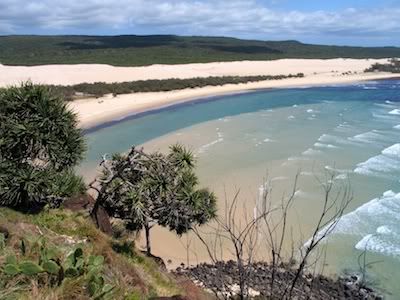
The largest sand island in the world, Fraser Island is located just off the coast of southern Queensland, about 200 km (120mi) north of Brisbane.  Its matching points on the mainland have it stretching from Tin Can Bay and Rainbow Beach in the south, up to Bundaberg in the north.  It can be accessed by ferry/barge from Hervey Bay (incidentally, a great place to go whale watching, but that's a story for another time) and from Inskip Point, or by plane.  If you plan on driving yourself around the island, you will need a four wheel drive vehicle and a vehicle access permit from DERM (Department of Environment and Resource Management).  Never fear, there are plenty of day tours available so that you can sit back, relax, and enjoy the scenery without the hassle of navigating on your own.

Although I have only been there one time, its beauty left a lasting impression on me.  To be honest, I was a little surprised at the extent of the lush vegetation on the island.  After all, it IS sand, and I guess I had the preconceived notion that not much grows in sand.  Well, once I returned home, I had to do a little research on that topic and found that there's a particular type of fungus present in the sand that releases nutrients in a way that allows the plants to absorb it.
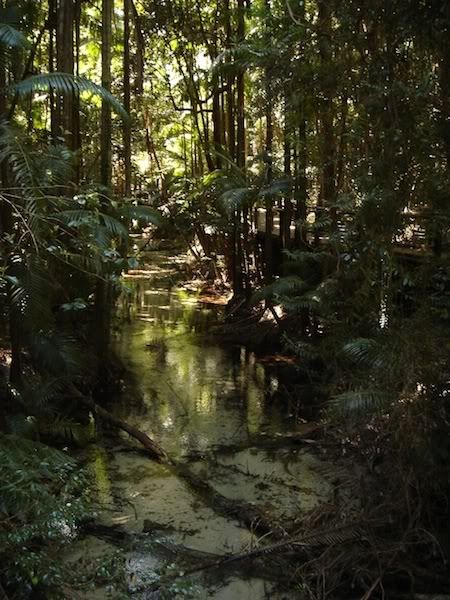
Rainforest on Fraser Island
What a vista!
My visit to Fraser Island was as part of a small group.  We were given a talk about the dingoes on the island, and advised not to feed them, as we could be fined for it.  You have to remember, these are wild animals, and  as such, they can be unpredictable.  I will say, though, that I never felt scared or threatened - they kept their distance and I didn't see that many of them.  It's just common sense not to feed them or leave food out unattended where it could entice them into encroaching on more populated areas.  My favourite thing about Dingoes is that they don't bark, although they can howl, which sounds eerie.  Look at the gorgeous golden coat on this beauty!  Zoom lenses sure do come in handy, don't they?
Fraser Island Dingo
As part of the tour we visited Lake McKenzie, which has to be one of the most beautiful lakes I've encountered in my travels.  The white silica sand is so bright it's dazzling.  Even the feel of it to walk on was quite different than the norm.  The most stunning aspect, however, was the water.  Simply put, it was the clearest, cleanest water I've ever seen.  I could see all the way to the bottom without the view being distorted at all.  Lake McKenzie is a very popular spot, so if you're going during peak season, I'd get there early to avoid the crowds.

Fraser Island is a great place to camp, with plenty of designated areas.  For those who like life's creature comforts, there are also a couple of resorts and guest houses which can be a bit pricey due to demand.  Your other option is to stay on the mainland and do a day trip out to the island. You can find accommodation here.

If you like to fish, Fraser Island is an angler's paradise.  Tailor is probably one of the most common you'll find, along with golden trevally, surf bream, flathead and whiting.  Are you getting hungry for some good, fresh seafood yet?

One of the well known landmarks on Fraser Island is the shipwrecked S.S. Maheno which was beached (on the Eastern coast at 75 Mile Beach) in 1935 and then later used for bombing target practice during WWII.  Unfortunately, I didn't get a chance to go and see this during my visit.  I guess that just means I need to go back again!  One last piece of advise before I wrap this up -- wear comfortable shoes, because chances are you're going to want to do a lot of walking and exploring.

Monday, May 7, 2012

Travel Tips

To me, travelling is a very individual experience.  By that, I mean that many people have quite specific opinions and ideas regarding how you should go about every stage of it.  For example, you have the super organized travellers who start packing a week before they leave.  Then you have the ones like me, who get it together the night before (or morning of) travel.  Do you wing it, or plan every last step along the way?  I fit somewhere in the middle of that statement.  Usually there are a couple of main attractions that you don't want to miss, and should be booked in advance (click here to look at your options) to make sure they're not sold out, or they may only operate on certain days/times etc.  I like to have a bit of flexibility for the smaller things, ones where your enjoyment might be affected by weather.  Don't forget to allow yourself a bit of a breather during your stay.  Since there is so much to see and do in Australia, no matter what area you're in, do you really want to be on the go 24/7, and too tired by the end of your stay to truly enjoy it?

Now, hotels are another matter altogether.  As long as I have a definite itinerary, I always book my hotels ahead of time.  There is something very reassuring about knowing that I have a place to rest my weary head at the end of long day spent exploring.  I recommend that you book all of your accommodations here.  Something to bear in mind is that in many areas of Australia, the distances between cities can be vast, and you don't want to turn up and find that there's no room at the inn.  You can refer to an earlier post about the size of Australia here, or check the map here.  

Ok, moving on, I thought I'd share a few general tips (and lingo) with you.  

  • Australia operates on 220 - 240 volts, so you may need a transformer (to covert from 110) and plug adapter.  Trust me, you don't want to fry that laptop or camera!
  • We drive on the left hand side of the road.  
  • We have roundabouts - remember to give way (yield) to traffic already on the roundabout.
  • Most Aussies refer to gasoline as petrol or fuel, not gas.  If you show up at a servo (service station/filling station) and ask for gas, they'll probably point you to the LP Gas bowser (propane dispenser).
  • Call your bank/credit card company before you leave to advise them that you'll be travelling.  You don't want to arrive and find yourself cut off because your bank thinks it's fraudulent activity.
  • Check your passport to make sure that you will have at least 6 months validity left after your return date.  Click here for a link about entry visas.
  • Don't forget to take extra memory cards and batteries for your camera.  There's so much wildlife, architecture and gorgeous vistas that you'll want to take heaps of photos!
  • Wear sunscreen.  An already lengthy flight home will feel like forever if you're covered in sunburn and crammed in a small seat.
  • Most important of all - have a bonza time!

Monday, April 30, 2012

The Sunshine Coast

It appears from my last few posts that I'm doing a Queensland theme, so I thought I'd stick with it and give my opinion on the Sunshine Coast.  Located just north of the capital city, Brisbane, the Sunshine Coast stretches roughly from Caloundra to Noosa, approximately 60km (37 miles).  There are 5 national parks contained within this area, so obviously it not completely developed and covered with concrete and buildings.

The coast is a great centre for tourism, and there are plenty of attractions and points of interest to keep everyone happy.  One of the most well known would be Steve Irwin's Australia Zoo, located at Beerwah, at the foot of the Glass House Mountains.  The Zoo is laid out well, with plenty of wildlife to see and of course the crocodile shows at the Crocoseum.  You know you can't miss that!  They also have elephants and tigers and such, in addition to the native Australian critters that you'd expect to see.

Glasshouse Mountains
Not far from Australia Zoo is Aussie World and Ettamogah Pub - a structure that has to be seen to be believed.  Filled with lots of fun rides for the kids, or a paintball park for the big kids, there's lots to see and do.  Also close by is the Buderim Ginger Factory, where you can do a tour of the working plant, enjoy other exhibits, shops and restaurants or rides for the kids.  To get an intriguing view of some ocean life, you can visit Underwater World, at the Spit in Mooloolaba.  (How are you doing wrapping your tongue around some of these words??? J)  I have to say, it's an awesome feeling standing in a clear tunnel, surrounded by huge sharks, stingrays, eels and all sorts of brilliantly coloured fish, close enough that it feels like you could reach out your arm and touch them.

Moving further up the coast you have a wide selection of beaches to choose from.  One of the things that many Australians take for granted is how lucky they are to have relatively uncrowded, beautiful beaches.  I guess that's one of the best parts of travelling; seeing how your country differs to others.  Some of my favourite stretches of beach are located near Coolum.  It's a smaller, quieter area than Caloundra or Noosa.  However, if it's nightlife and culture you're after, then Noosa is the place to see.
Noosa
In the hinterland, you have a very different atmosphere.  There are a couple of scenic towns, Maleny and Montville, set up on the Blackall Range overlooking the Sunshine Coast.  These quaint little townships are almost like artist retreats, so there are lots of galleries to peruse and craft work to admire.  For the wine connoisseur there are some boutique wineries to stop and sample at along the way.

For the sports fans, there's horse racing at Corbould Park in Caloundra, more than 10 golf courses to choose from, and the Big Kart Track (Go-Kart racing) in Landsborough.

All of the places I've mentioned are possible to visit as a day trip from Brisbane, but to really see and enjoy the area, I would suggest spending a couple of days on the coast in one of the smaller towns so that you can get a real feel for the place.

Noosa Heads

Travel Guard - The Best Travel Insurance